The Perks of Living in a Semi Real Universe
The discourse around the simulated nature of the universe depends on a dichotomy between 'real' and 'simulated' that may be false. Before we dive into that, let's discuss probability: if there's only one 'real' universe, and a billion 'fake' universes, then the chances of being in the real one are a billion to one. Let's assume we live in a simulation then and talk about what assumptions we can make:
- If there is a spectrum of how lightweight or 'fake' the universes are, the more fake, the more likely we are in it.
- Faithful simulations created by a parent universe are themselves capable of creating simulations.
- A tree of simulated universes emerges, with the finite computing power of the root universe divided among its descendants.
- The lower bound of "realness" is set by the imperative to use the least computational resources possible; the upper bound is the requirement to remain capable of creating a viable child universe.
- Whatever efficiency strategies the universe employs, it cannot destroy information required to produce a child universe. Thus its intelligence capabilities, including us humans, should have a self similarity with how the universe works. How our mind solves for efficiency should give us a clue for how the universe does it.
- A universe need only be "real" enough for its intelligence systems to function well enough to create a child. Computational resources for perfect data consistency should be spent only where they serve this goal; all other data can remain temporary, inconsistent, or lazily rendered.
- 'Real enough to self replicate' then can be used as the actual definition of real, and the false dichotomy between real and simulated can be discarded.
- Given finite resources in the mother universe, her role is to prune less viable child universes and reallocate computational capacity to those with higher potential.
- If our sperm is going to make it to the egg, our goal is to figure it out how to build a child universe, or else our lights could be shut off.
[only 4-7 are interesting points]
With these assumptions, the task ahead is to figure out how these algorithms would work.
Self Replicating States
The universe can be divided into its elements and their various states. From this perspective, life can simply be described as a self replicating state with the goal of recruiting as many elements as it can, eventually creating a child universe to replicate into when that becomes easier than recruiting from its native universe. A universe is essentially a sandbox that can or cannot build a self replicating state strong enough to build its own child sandbox.
A planet's vast programmable neural network can be described in similar terms. Our brains control our bodies, which can build a house around our brain by recruiting those elements, but our minds themselves are recruited by behaviors. Neural recruitment by self replicating states is the source of our interaction with the real world. What happens in the classical world depends on what happens in the neural world.
Instead of calling them self replicating states, we can simply use the word autoklon. It means a self-perpetuating pattern, or any configuration that acts to keep itself in existence, so that it persists and reproduces rather than dissolving.
An autoklon can be a stable structure in matter, a cell assembly in a brain, a habit, an idea, an institution, a caste. It only has to have one property: it participates in maintaining its own continuation. The single necessary feature is some way its own activity feeds back into its own survival.
A rock isn't an autoklon, it just sits until eroded. A whirlpool is closer because it actively re-forms, but only while the river drives it. A neural cell assembly that fires, strengthens its own connections, and thereby fires more readily is exactly one. The dividing line is whether the pattern does something that makes its own recurrence more likely.
Since how our intelligence works and how this universe works should have a self similarity, it should help us to understand the universe deeper. Let's talk about our brain's main concerns.
Dimensional Complexity
The first problem you have to solve is what to pay attention to. Which pixel is most important? How do you drown out noise? Seriously, cafe s can be loud, but somehow people sit there and get work done.
The problem with too much data is that adding variables has a greater than linear effect on resources required to process them..
In some situations, reducing variables is simple. If a policeman is looking for a suspect in a yellow car, the algorithm is:
- Check color of cars passing by
- If not yellow, ignore
- If yellow, commit more brain power
Looks easy, but what about deciding on a profession? If that was easy, everyone would be successful. The algorithm would look something like this:
- Determine what success is
- Looks like money
- Could be leverage
- What about love?
- Try to understand the world to get a better sense?
- How do we know when that happens?
The need to break the problem down into more manageable pieces makes itself apparent. At the end of the day, we are choosing which behaviors to imitate. This does not have to be a profession, this can be any behavior: how we talk, whom we talk to, hobbies, interests, which t-shirt to wear, etc.
The usefulness-interest dilemma
The more useful a behavior, the more complex it can be. For instance, think of the decision tree of building a house versus doing drugs.
Given how useful houses are, you would think everyone would first try to build a house before doing drugs, however drug use does not take much work. Simply as a behavior, it is easy to imitate. Interest is not a measure of usefulness, it is a measure of neural penetration. Given that our brain has to economize its resources, useful behavior often presents an object too large to be accepted when we have simpler options in front of us.
Since behaviors have a high neural cost, a behavior has to evolve to reduce the processing power to takes to be processed, or else it would go extinct. Virility of a behavior and its neural processing cost have an inverse relationship.
In other words behaviors have to be arrow shaped: pointy at the front to get noticed, heavy in the back to match the complexity of problems it must solve. Pointiness gets a behavior noticed and acts like a hook that lets the rest of the behavior pull itself in. The problem is that we understand a behavior one slice of the pointiness at a time, starting with the tip. If a behavior isn't pointy, we may not even notice it, and the deeper a slice we are looking at, the more computing power we need to look at the next slice.
Signal Detection and Value Distillation
To solve the dimensional complexity problem, we must find a cheap way to gather information about behaviors when we don't even necessarily know what we're looking for. Since we are searching for the most valuable behavior, if assume we know what it looks like, we could be searching for the wrong thing. How we find the candidates must be computationally cheap, since we have such a breadth of candidates to scale it on.
To solve the usefulness-dilemma problem, we must funnel what candidates we find into a process where we gradually increase the computational power used to evaluate behaviors. We reduce the candidates as we learn more about them, saving the most costly analysis for the best ones, increasing our knowledge along the way. This can also be described as resolving complexity. In other words, a good search algorithm is a good compressor.
Claude Shannon proved in his groundbreaking 1948 paper, A Mathematical Theory of Communication, that the limit of compression depends on the probability distribution of the data. To compress optimally, you must predict those probabilities. Thus, if our minds are a prediction machine helping us to sustain ourselves, to describe this distillation process is to understand how our minds work.
Since behaviors want to be noticed, and thus solve for their own pointiness, its important us to choose filters in the distillation process that can't be gamed.
Authentic Signals of Increasing Complexity
For an autoklon to survive on our shared neural network, it must solve for two things:
- Neural recruitment: it must recruit our neural resources.
- Neural retainment: it must defend its turf from other behaviors.
To keep things simple, we can just measure which behavior to imitate based on social proof signals. If a behavior was able to achieve recruitment and retainment, you'll be able to tell from observation. The forgeability, or how easy it is to fake a type of social proof becomes paramount. Some behaviors are easy to notice, but are also easy to fake.
We must find a small number of social proof datapoints that are hard to forge and represent sensible points on a scale of complexity.
Table of observability and forgeability per social proof signal:
| Proof of... | Observability | Forgeability |
|---|---|---|
| Wealth | High: easy to notice | High: fake jewelry is common |
| Usefulness | Low: takes a long time to process a proper feedbackloop | Low: very difficult to fake something actually useful |
| Popularity | High: by definition, everyone knows | High: you don't actually know what others think |
| Risk | Very low: easy to notice | Low: maybe the hardest thing to fake |
| Work | Medium: takes some domain knowledge | Low: even forging work takes work |
| Benefit | Low: winners don't have incentive to tell others | Medium: people can fake wealth, health, etc |
Of the social proof signals listed, the most abstract are the most versatile and useful: Proof of risk, proof of work, and proof of usefulness. They seem like important steps to take in analyzing a behavior going from least neurologically expensive to most. Let's go over each step.
Proof of Risk
[energy detector example: predators don't chase prey until the prey starts running]
Its important to remember that, if this is the first stage of the process, we know nothing about the signal. If we don't know what it looks like, how do we detect it? With an energy detector, as described by Harry Urkowitz in his 1967 paper, Energy Detection of Unknown Deterministic Signals. The paper outlines a way to detect a signal without knowing anything about it by measuring the energy of its signal.
This explains why sheep who see other sheep accelerating quickly from a single point also run the in same direction without knowing what they're running from. Since the sheep expanded massive amounts of energy, which is risky, that behavior stood out from the noise and copied itself.
Large displays of risk are very interesting to us because we relate to one another: walking a tight rope over the Grand Canyon is obviously dangerous; taking your clothes off in public reveals private data; risking your fortune on one stock means it better go up.
The neural cost of proof of risk is small because, assuming the person is not self destructive, they must expect a large reward. Since we have the same needs, perhaps we should compete with them for that reward.
Proof of Work
Work takes more time to process. For instance, how do you know someone is a good painter? What makes one painting better than another? Is painting more work than computer graphics? Some experience is necessary to be able to tell how much work someone put into something.
Let's compare DaVinci's Mona Lisa with a child's stick figure drawing. We know intuitively who gave more of their brain to the craft, but how do we describe things more rigorously? We know the painting is just an artifact, the real signal is the behavior that created it. The unknown parameter of the signal that's hidden is how much of DaVinci's mind did the process recruit.
The difference between risk and work is time. Work takes more time, and we can use this as an advantage. Generalized Sequential Probability Ratio Test (GSPRT) is designed for exactly this situation. GSPRT, described by Pollak and Siegmund in their 1975 paper, Approximations to the Expected Sample Size of Certain Sequential Tests, is a sequential hypothesis test that watches a stream of observations one at a time, continuously updating a running score after each one. At each step it asks: given everything seen so far, what is the most credible estimate of the unknown underlying parameter, and how strongly does the evidence favor one hypothesis over another under that estimate.
Each stroke can potentially ruin the picture, so statistically speaking, the Mona Lisa had many more chances to die, yet here she is. Work can be defined as a series of small risks that end up creating some predetermined outcome. We can't necessarily model the risk of every brush stroke, but we know it was much more than it takes to make a stick figure.
In this case, each little risk of the stroke slowly reveals the proof of neural recruitment. But how useful is painting? Would you like to be dropped off on an island of artists or farmers?
Proof of Usefulness
As interesting as a painting can be, someone had to make the easel, create the paints, construct the buildings housing it and the painter. If everyone became a painter, what would we eat? Work and risk that don't beget more work and risk will lead to the end of a civilization, so we have to find the processing power to separate useful from useless behavior.
If a behavior has gone through the proof of work stage, we have quite a bit of knowledge about it. If we have any goals in mind we would like to accomplish, we also know what gaps we need to fill. So what we really want to know is whether a signal will reduce future complexity.
Since we have a known gap we want to fill, and signals that we know a lot about to fill them with, this is a similar problem to the faced by anti air technicians in World War II. In order to detect air planes, a radar pulse was sent out and a return echo was measured from the noise. Since they knew the shape of the radar pulse, they knew what the echo would look like. Thus matched a signal to a template.
This technique was formalized by D. O. North in his 1943 paper, An Analysis of the Factors which Determine Signal/Noise Discrimination in Pulsed Carrier Systems, and is called matched filters. Notice that matched filters requires us to go through the earlier stages in order to gain knowledge of the signal and which gap it fills.
[put more emphasis on how important ]
Social Proof Distillation
Using these concepts as first principles, we can build a visual model of how our brain works.
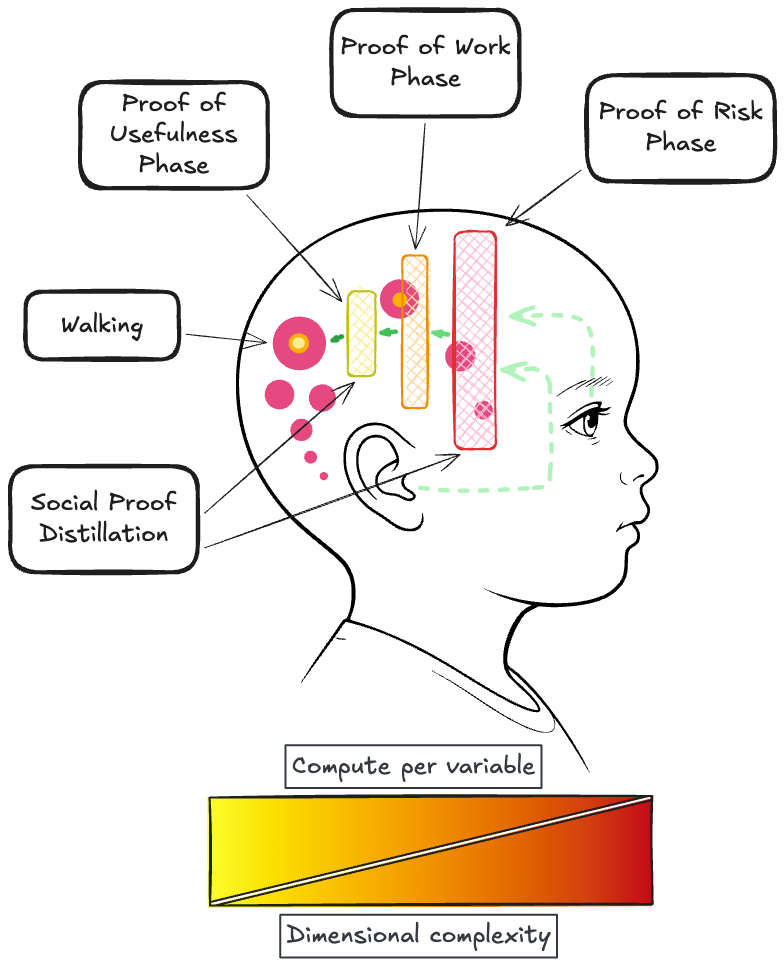
As our sensory organs create data, we pass the data through phases. Since risk is easy to identify, the first phase considers many instances of proof of risk before passing the most promising data to proof of work. After evaluating the data for proof of work, which takes up a lot of our time, it passes it down to be evaluated again to see if we should optimize the work to signal proof of usefulness. As a behavior passes through each phase, the amount of variables and dimensional complexity reduce, but the amount of compute per variable increases.
These are essentially milestones in a parallel distillation process. They are abstract and not necessarily 'real', but they help us think about what must be happening in our brains as we traverse the universe. This process takes a long time to develop: the simplest layer, proof of risk, is the first to be created, and the rest follow from there.
They also don't necessarily have to follow the described order. It helps to know that a useful behavior inspired its host to invest risk into it, but it's not strictly necessary. For instance, if your father was a doctor, and you blindly follow in his footsteps, you end up taking the risk of attending medical school, even though you did not consider it to be a great risk.
This system requires two things to develop: time and support from others. This explains why children and the poor are so prone to high risk low reward behavior. Simply put, the more complex the behavior we have to validate, the more complex the validation layer.
The question then is, what is the data that is deemed 'valid' enough to assign resources to? What does it have? How do we abstract out the validity?
Vercontrinaus
The further the data gets in the validation layers, the more conserved it is. Because that data is both difficult to fake and useful, it is a currency. It doesn't have to pass every layer. For instance, simple proof of risk that has no value, such as petty violence, is conserved in certain populations. If data is conserved at all, it can be said to have vercontrinaus, and the more valid it is, the more vercontrinaus it has.
Vercontrinaus, or V for short, is an attribute of data that has recruited enough human neural time to be deemed conservable, and thus is 'real' in the sense that it is non fungible and is useful enough to pass the test of time.
V can be treated like a substance with attributes like quantity and density. For instance, when one idea replaces another, we can say it has more V. It's the reason people hate it when you say no: agreement is simply the path of the flow of V, and the anger in disagreement is an expression of its momentum when being impeded, like the splashing of a river against its banks.
After going out to eat, you remark that the gastro pub's fancy meal was great, but the simple steak from last week hit the spot harder. What you really meant to say is the steak had more vercontrinaus. Sure, the work behind fancy layers of flavor created by the renowned chef was impressive — he must have gone to culinary school. But the cattle's beef was also a product of the risk of becoming a farmer, the work of herding the cattle, and the optimization of selectively breeding bovine to produce such a steak created a more concentrated V.
When Genghis Khan conquered Europe and Asia to create the biggest empire in history, his forces winning battle after battle across the land can be described as a more dense V flowing across the globe and reallocating the resources of the old V. The risk, work, and optimization of being unconquerable were done better by the Mongols in their day, or in other words, they had more V.
Galileo's telescope was a medium for the flow of V that recruited our collective neural resources enough to replace the previous, less powerful, V of geocentrism. If your LLM model is better trained than another's, your model has more V. Vercontrinaus is not just about people, it is an abstraction that works for humans, animals, machine intelligence, and perhaps the universe.
General Intelligence
If V can be described as a substance that is useful and difficult to copy, then it is persistent. There are both a lack of means and a lack of incentive to destroy any V, which means it is capable of creating neural pressure. Two incompatible behaviors with similar V cannot coexist on the same neural resource, so at some point our brains are full and we must either transfer some out or forget it.
Transferring V conjures up images of direct communication, such as teaching someone a skill. It doesn't have to be a conscious effort, though, so stress experienced at work can become abusive behavior in the home. But really, all behavior is an expression of, and therefor transfer of, V.
Given that V means neural recruitment and retainment, any task requires a bit of it, and the accumulation of neural pressure explains the expression of the behavior. Our ability to learn how to create V creates our ability to learn any and all none trivial behavior, which explains why it takes so much longer for humans to mature than other animals.
A simple example is babies learning to walk. Four legged animals can learn the same day they are born. That's because having four legs means you are self balancing. Lifting a leg to take a step is also easy because three legs are also self balancing. The simplicity of walking with four legs makes it possible to create a hardwired, specific behavior for walking.
Humans, on the other hand, should maximize general intelligence because we have such a wide breadth and depth of problems we must solve. We must be able to learn to close very large gaps, so fluid, adaptable learning mechanisms must be maximized at the cost of minimizing hardwired specific behaviors.
Walking is a very big problem for us because we have very little incentive. Our mothers bring us to the milk, where as a calf has to stand to reach its mother's teat. Learning to walk for us does not have a forcing function, nor is it simple, which is why we take a year to learn it. So, what are we learning between being born and walking?
Before we learn to walk, we learn to observe proof of risk, and having observed enough of it to create neural pressure, we relieve the pressure by transferring it to our parents when they observe us walking. The reason we walk at all is that walking has the risk of falling, and watching others take that risk over and over eventually caused walking to be expressed through us.
In other words, when we observe children picking up bad habits with all risk and no reward, we are watching the side effects of our intelligence system. Without that stupidity, intelligence doesn't happen.
The best part about V is that it transcends modality: visual, audio, text, all can express proof risk, work, and recruitment. In essence, vercontrinaus is what makes things 'real' in our minds, and allows our physical harness to render ideas in neural voltage.
As our minds develop from primitive risk oriented behavior to intelligence systems capable of producing proof of neural recruitment, the outer world that our senses perceive becomes a proving ground that provided feedback to the behaviors evolving to compete for resources on our shared neural network.
Behavioral tensegrity structure
As a baby learns to walk, the walking behavior has so much more V than anything else it does, it easily replaces any other activity and therefore recruits the neural power it requires. Other behaviors, on the other hand, are similar in value to each other. How do we decide which one to go with if they clash?
Imagine eating as a behavior and a node in a network, with 'because it's health' and 'because it tastes good' as two children behaviors. They are two justifications for eating something, however they don't always contradict each other, so for now they get along.
If satisfying both sibling behaviors equally worked until you turned 40, and suddenly the same food you've always eaten is now making you fat, you may choose to eliminate the 'because it tastes good' node. This sounds trivial until you realize what happened.
- The two siblings got along okay
- We have new feedback from the environment
- The two siblings are no longer getting along, and the one with less V was on the chopping block.
The siblings being attracted to the parent, but repelled by each other forms a structure with tensional integrity, or tensegrity, something common in architecture, civil engineering, and even rocket ships.
The big question is, why did we ever have 'because it tastes good'? We probably were always a little heavy, and as long as things don't taste bad, their real value is nutritional, anyway. To illustrate this, let's think about tensegrity on the social scale.
Social Integrity Tree
- Restaurant manager is afraid of doing front of house.
- Front of house is creating problems and seems to be steeling.
- Manager takes the risk and learns to do front of house.
- Staff is reduced by one, but more importantly, restaurant complexity is reduced.
Restaurants can be described as front of house, back of house, and management between them. Each behavior is a neural cluster occupying someone's brain, with a social instead of a neural connection between them. We are operating across an air gap separating isolated nervous systems.
The restaurant is in trouble: they can probably make it through, but tourist season just ended, and seafood is not exactly McDonalds. The manager has been adding up the cost of food going out to tables, and it is less than the money coming in. It is always happening when a particular waiter is on shift.
The manager has never worked front of house, but he knows if he gets rid of the waiter, he will have to take over their work. This is a time to take a leap, he thought, and bit the bullet and replaced the waiter. His work was not outstanding at first, but he adapted, and became good enough to not impact the bottom line. Eventually he learned enough about front of house to run it more efficiently as a manager and reduced the need for staff.
What happened? As one of the neural clusters started sending complexity up to the parent, the parent node took a risk, did some work, optimized a little, and eventually reduced the complexity of the restaurant as a whole. Notice that his interaction with the environment took some risk and some work, and that resulted in learning new behavior. As if emitting vercontrinaus illuminates the world.
Vercontrinaus illuminescence
When you began to walk as a baby, the corner of the coffee table went from obstacle to danger. The wall you used to simply pat with your hand can now bruise you. We use V to color the world and give it charisma. Without that, it would have little neural penetration, and would fail to recruit enough of our brain to understand it.
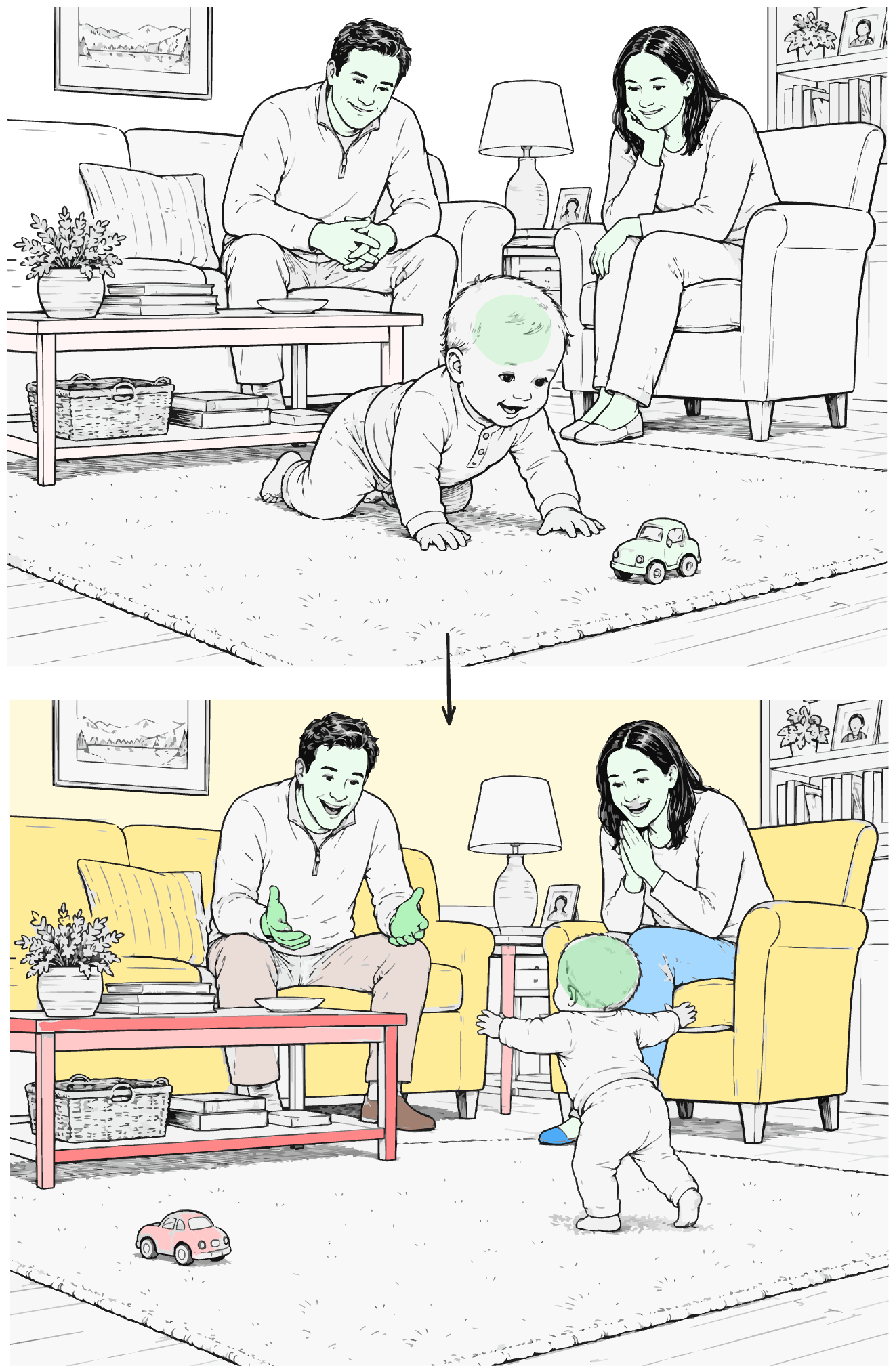
Intelligence and courage seem to be in a self perpetuating, self building feedback loop. The development of social contracts, recipes, and even languages now has a mechanism behind it.
There is no real reason to not renege on a deal unless you want your word to have V. For instance, between 1785 and 1815, the Americans and Europeans both experienced constant betrayal at the hands of their North African trading partners, which resulted in three Barbary wars. Well meaning Western traders were enslaved, ambushed, and killed even after signing treaties and sending tribute payments for 'protection' and safe passage in the Mediterranean.
The result of their treachery led the Barbary civilizations to be conquered and absorbed, while the US and Europe continued to flourish and grow. One could say our trade agreements had more V. In a way, all written contracts are really social contracts, and all behaviors are an expression of vercontrinaus.
The evolution of recipes can be described as the result of emitting V for the sake of it. Street venders in places like Thailand often sell coconuts with various gimmicks. Coconuts in general are just okay, and tourists partake more because they saw it on youtube than because they love the fruits. Some venders have now resorted to roasting the coconuts.
We all know they aren't going from okay to amazing because they are roasted, however we also know the application of fire takes some work. They've introduced a constraint where your coconut could be burned or undercooked, and consuming one is a measure of the vender's competence. This introduces some risk and work to an otherwise common product. Caramelizing meat until it's brown, which has little value, is now a part of every meat recipe. It's useless in a stew, but everyone does it because it has V. Now we know we how got there.
If a contract or a recipe is an expression of V, but what about words in general? In resource rich environment like the jungles of Central Africa, volume, pitch, rhythm of grunts get the job done for Chimpanzees, because when they're hungry, they reach into a wild tree and grab some fruit.
But if you are a nomad in Central Asia and need to communicate to your mate what food to pack the next time you move, you need to be able to count things, name them, and order them by importance. If she thinks you only need 8 pounds of meat, but you know you need 12, you need to be able to produce neural pressure to get her to change her mind. You need an explanation and, an excuse, leverage, or simply say it the right way, but you need to take some risk and do some work and make some V.
As we illuminate the world with V, the need to understand and solve increasingly complex problems leads to demand for increasingly complex language constructs. Landing rockets on Mars takes some rocket science and a lot of fuel, but really we need to close the air gap between some brains and create neural pressure.
V Conserves Neural Voltage
Why exactly an idea, in the form of a synaptic cluster, can processed in different parts of your brain is complicated, but we can simply say your brain is a circuit, and it does it with voltage. To a single brain, V gives data value. But a network of people is a collection of air gapped, isolated circuits.
To close the air gap, we need to cross from the neural regime to the classical domain, where Newtonian physics rules, and data is consistent and compressible.
A building constructed to be formidable, comfortable, and convenient will radiate those signals to those who encounter it. It is indeed a useful signal that's hard to fake. Buildings like this are rarely alone. If a civilization can build the White House, it probably has many such buildings, and they probably cluster. The White House can be said to have vercontrinaus.
Without data consistency and compressibility in the classical regime, the builder's ability to compress the complexity of building, and the observers ability to imitate them would be obstructed. Thus our mind's ability to expand complexity in understanding, and compressing complexity to create V, needs the classical regime not only as a communications medium, but as a validation facilitator. Without compressibility there is no V, and without consistency we can't transfer it as information.
Conspiring to compress
The classical, Newtonian realm of physics is not neutral in the fight against complexity. It is actively biased toward compressibility.
[couple of general examples]
[Gas can be described simply as volume and pressure]
[As gas is mixed together, it looses information]
[Just entropy is steerless compression of information, results in heat death]
[increasing information that leads to further compression however leads to civilization]
Expanding to Compress
[As entropy lowers information and results in heat, like he gas expanding out and being effectively described as temperature and pressure, ]
[practical examples]
[physics as an example]
[How do we select which complexity to elaborate?]
Autokrasis
[It looks like to go against entropy is to create information and complexity. This seems like a bad idea, but we did not turn iron ore and carbon into a car engine, what would civilization look like?]
[If we create complexity, but as a result get a reduction in total complexity, we had a compressive profit.]
[That in this universe we can show compressive profit that leads to more profit is why civilization is possible at all.]
[At this point, we need some new terminology. To compress complexity is called Haplokrasis, and to increase it, polykrasis.]
[The self sustaining loop that tries to get a haplokrastic result is called autokrasis.]
[But if that information helps to compress further, we have a haplokrastic result. Is the haplokrastic profit the creator of civilization]
[Social proof closes the gap between brains, V is required for voltage conservation.]
[Need a behavior where you emit V in a way that leads you down the same path. Fighting looks like a good]
[Make the connection between social proof and interacting with the classical state to collapse th quantum state.]
[The classical regime is not just a communications medium, it helps to validate V ]
[Classical layer is has data consistency and compressabilty in its design to exactly serve the neural regime. ]
[As high V signals propagate out in the classical world, so do gamma bursts propagate in the neural regime]
Designer to Player Interface Constraint
A video game designer has to make a video game that takes up as little ram as possible, however if it is simply an empty white room, who would play it? The player's intelligence system must be satisfied with getting some sort of work done in the game, thus creating V, and the universe has a similar interface constraint with whatever intelligence it houses.
Our basic existence is happens in Newtonian physics, because
This would mean, for instance, the dark side of the moon is not actually rendered until someone looks at, and if that person did not create a strong enough signal, it may deallocate those resources and rerender again later.
Let's say Steve, a wealthy entrepreneur, buys a rocket and travels to the dark side of the moon, but he does not tell anyone what he saw. Chau, on the other hand, does the same thing but takes pictures and shows everyone it is green. If Steve interjects in Chau's press conference and says it was yellow when he went, no one will care. It will have no impact and so the rerendering was a good move.
Vercontrinaus and Superposition Collapse
The dark side of the moon rerendering based on ocular occlusion is large scale resource management, but what about the stuff that makes up our atoms? If we are made up of small enough particles, what we are looking at in everyday life can simply be the average composition of a inconsistently rendered chaos on the atomic level.
Super position collapse, for instance, can be explained as the universe's implementation of vercontrinaus. The double slit experiment showed us that photons act as waves when not observed, so they create a probabilistic result when passing through the two slits. As soon as the results are observed, the wave collapses into a deterministic path.
Which has more V, a probabilistic or deterministic result? If Bob and Amy both do work to repair a roof, but Bob's solution may prevent the rain from getting through, while Amy's work definitely solved the problem, Bob's work is counterfeit and he should ask Amy how to do better. She has more V because hher proof of work signal is stronger.
Thus, the universe does less work to render waves just like Bob did less work to fix the roof. It is a method to conserve computational resources. Vercontrinaus allows entanglement between intelligence systems and bridges the gap between isolated circuits. The different parts of the same brain use voltage to talk to each other, but people use V.
The big question is, 'does this work'. Can you build a universe where realness is not binary, but an attribute with a degree of intensity based on how important it is for the universe to replicate itself? It's better to ask yourself, why do you think that realness is anything but a measure of virility? Perhaps a competing self replicating state convinced you.
Given that you can build more universes the less computational resources each one requires, if 'semi-real' universes out number 'real' universes enough, the alternative to V based computation may not be worth considering.